
Tips for Organizing Paper!
Remember the five-minute rule mentioned in our previous Baby Steps to Organization post? That simple guideline is an excellent way to evaluate whether your system for handling paper is working. If dealing with incoming paper takes five minutes or less, you’re likely on the right track.
My approach to paper is straightforward. I don’t claim to have everything perfectly under control, but I use a few simple, repeatable systems to keep everyday papers from piling up and taking over the house.
Here are the basic systems I use for day-to-day sorting:
1) Recycle immediately.
As soon as paper enters the house I check whether it’s needed. If not, it goes straight into the recycling bin. To make this easy, I keep a recycling basket in the kitchen pantry so there’s no excuse to drop papers on the counter or leave them scattered. Eliminating those little piles makes a big visual difference.
This is a photo of an oil cloth bulletin board. My current board isn’t quite as polished yet, so it’s not pictured here.
2) Use a central bulletin board.
We have a “family central” bulletin board where important, time-sensitive items live: concert tickets, passes, coupons, or anything someone might need to find quickly. I periodically clear the board of outdated items. Having one obvious spot for those papers simplifies everyone’s life.
3) Use the back of the pantry door for school papers.
School-age children bring home a lot of paper every day. Without a designated place, those papers can become overwhelming. I sort through school papers after school and recycle what we don’t want. Current school notices, lunch menus, and calendars get taped to the back of the pantry door. It’s not perfect or pretty, but it’s functional and keeps everything in one place.
4) Keep a bill basket.
All incoming bills go into a bill basket on a pantry shelf. I open each bill, discard unnecessary inserts and envelopes, and place the statement in the basket. We pay bills online twice a month; after payment, the bill moves to a “paid” file drawer. At year-end I recycle old statements. Whenever possible I sign up for paperless billing—fewer incoming papers equals less to manage.
5) Maintain simple family files.
I’m not a fan of extensive filing systems—file cabinets hide things from view—but I do keep one drawer for family files. Each family member, including our dog, has a medical file plus a general file. When I need to check something like an immunization date, I go straight to that person’s medical file. I keep basic photocopies and essential records rather than elaborate, color-coded binders.
6) Store keepsakes in personal bins.
There are always papers family members want to keep—school drawings, awards, or clippings. Each person has a labeled plastic tote stored in a closet for those items. It’s an easy, low-cost way to give keepsakes a home without letting them take over the living spaces.
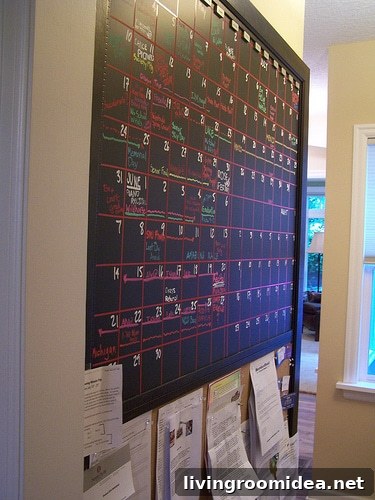
A simple command center or calendar with a nearby pin area keeps papers organized and visible.
How do you deal with paper?
Catch up on the other organizing tips in this series:
Baby Step One: Assess the Needs
Baby Step Two: Are you a S.H.E.?
Baby Step Three: Embrace the Five Minute or Less Rule
This Friday, join a Creative Organization link-up. Share posts—recent or past—about how you keep your life organized. Contributions can cover any room and don’t need to be limited to paper organization. Let’s see practical ideas that are also attractive.
Top image: a friend’s “family central” organizational calendar. I love that it combines a dry-erase calendar with space to pin up papers nearby.