
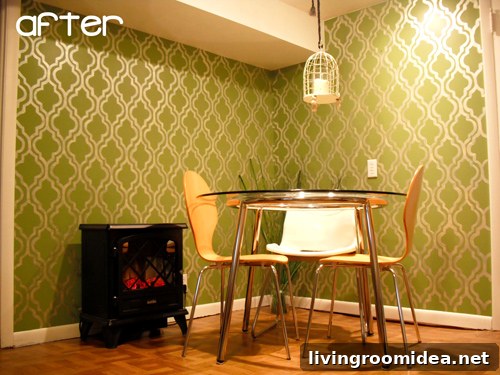
Coming off our own adventures in stencil land, we had to share this note from Ginny, who stenciled her dining nook earlier this year. Her results are dramatic — the patterned wall transformed an ordinary corner into a true dining area. Here’s Ginny’s account of the makeover:
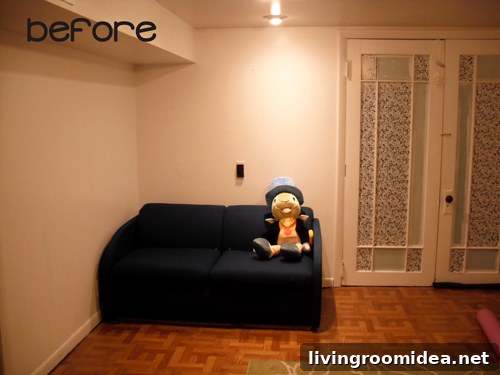
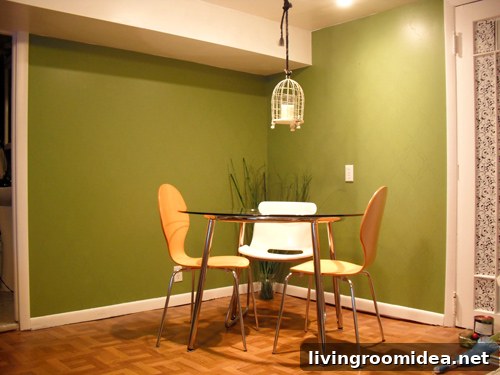
I wanted to create a dining corner in my living room. I had purchased the table, finally got the chairs I wanted, and tried to style the space, but it still felt like just a table stuck in a corner. Then it hit me: it needed color. I wanted the color to coordinate with my living room, so I introduced green to tie into the carpet.
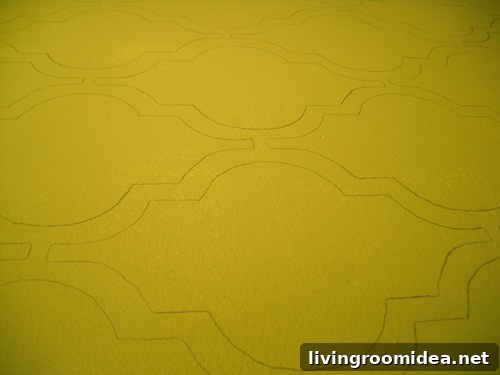
I found a post that inspired me and followed the tutorial it referenced. I cut out the template, traced the pattern onto the wall — which took about 4.5 hours — and my hands were sore the next day. Painting the lines took even longer, but the effort paid off.
Now I’m absolutely, positively head over heels in love with my dining area! – Ginny
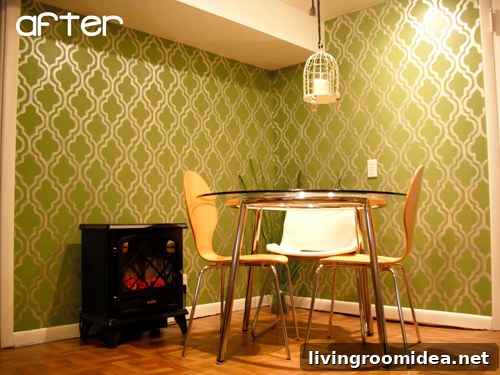
We love how the bold color and repeating pattern turned a bland corner into a focal point. The stencil gives the small dining area personality and makes it feel like a room within the larger living space. Ginny’s process shows that, with patience and planning, a DIY painted pattern can closely mimic wallpaper but with the flexibility to match your exact palette.
If this project inspires you, consider adapting the scale, hue, and repeat of the stencil to suit your proportions and décor. Lighter tones and more subtle contrasts create a soft, textured look, while saturated colors and high contrast deliver a lively, modern statement. For placement, anchoring the pattern around the dining table and seating height keeps the eye focused where you want it.
Have a before-and-after of your own? Send your story, photos, and links to [email protected] to be considered for a Reader Redesign feature. We love seeing creative, budget-friendly transformations and the ways readers make spaces their own.