
Update and add charm to a kitchen on a budget
A
Are you ready to update your kitchen? Do you want to add charm and personality but aren’t sure where to start? Creating ambience is the key to having a truly beautiful home.
You know how magazine rooms can look perfectly decorated yet still feel like something’s missing? That missing element is often ambience — the subtle quality that makes a room feel warm, personal and inviting. Ambience can come from accessories, but the architecture of a room plays a huge role too.
NOTE: You can see some of the BEFORE photos of this kitchen here. It is quite surprising how much transformation was possible on an affordable budget.
Homes that feel most charming often retain personality even when empty. While you can’t always change structural architecture, you can often trick the eye into perceiving more character through thoughtful details and inexpensive tweaks.
I renovated the kitchen in my old English-style house on a realistic budget. Since we no longer live there, the photos I have aren’t perfect, but they tell the story of how a dated 1970s kitchen became a cozy, character-filled space without a full gut renovation.
My approach was to add personality in small, affordable ways that add up to a big impact. I worked with the existing layout and focused on details that felt custom but didn’t blow the budget.
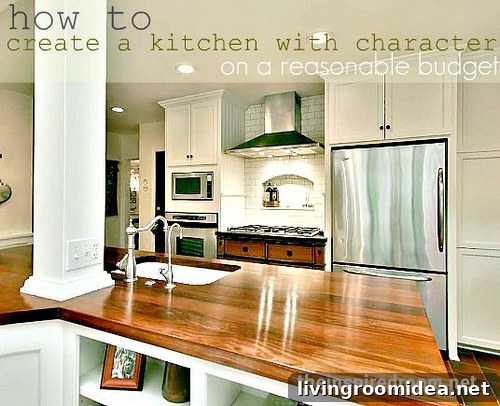
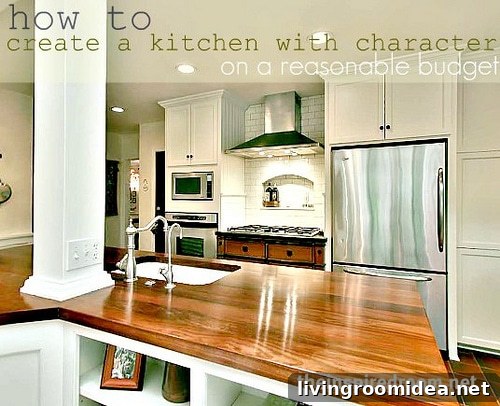
One of the first changes was the sink area. I wanted the look of an apron-front farmhouse sink but the cost was prohibitive. Instead, I used a similarly sized sink and created an inset apron look with surrounding cabinetry. The result reads like a farmhouse sink without the expense and gives the space its own distinctive character.
Look closely at the wood around the sink — the curved cutout was a happy accident. It’s the shape left from rounding the wood, and I asked the contractor to keep it. That little, unplanned curve added unique personality at no extra cost.
I also searched for faucets with character and mixed countertop materials: soapstone paired with Brazilian cherry. The soapstone was low-maintenance with monthly mineral oil treatments and provided a timeless surface. The Brazilian cherry was handcrafted by the contractor; while not cheap, it was less expensive than granite and created a warm, old-world feel. We sealed it with Aqua Spar to preserve the natural tone.
Under the counter we added decorative brackets. A local store provided curvy brackets that felt special but were affordable. At the island ends we used different treatments — beadboard on some ends and recessed details on others — again, no extra cost, just intentional design choices.
To make the kitchen feel more like a living space, I insisted on book storage. A small bookcase found a home in leftover space behind the sink and dishwasher, adding warmth and a lived-in feel.
Between cabinet banks we added open shelves to display colorful pieces. Beadboard on the shelf backs and porch-style brackets reinforced the English cottage vibe and tied the details together visually.
Where possible we reused existing cabinet boxes and installed new doors. This saved significantly on cost while giving cabinets a fresh look. Crown molding across the tops created a custom appearance. The cabinet color is a soft Antique White, which suits older homes and reads creamier than stark white.
To achieve a built-in look for the full-size refrigerator without the expense of cabinet-depth appliances, we recessed it into the garage so it wouldn’t protrude into the kitchen as much.
Rather than making every cabinet uniform, we mixed textures and finishes. Some cabinet ends received beadboard (using the back side for a subtle V-groove), and one bank got glass doors to break up the visual field. I considered a full subway tile backsplash but chose to tile key walls only, creating the feel of extensive tiling without the full price.
Hardware variety was another low-cost way to add interest. We selected four styles of hammered black iron knobs and pulls plus glass knobs for the display cabinet. Mixing hardware styles added a collected, layered look with no added expense.
A custom cabinet with four working drawers was built to house the stove and pots and pans. Rather than matching every cabinet to the rest, this piece was designed to resemble an antique furniture piece. We applied real bamboo trim — cut and burned for character — glued to the cabinet face and added small hooks for potholders. The result felt unique without a significant price difference from a plain cabinet.
A niche above the stove became a subtle focal point. Although it required a bit more budget, the niche dramatically enhanced the stove area and tied decorative elements together. We chose a darker grout with the buttery yellow subway tile to harmonize with the existing rusty-toned tile floor, which we saved to keep costs down and create a coherent palette.
For wall finishes I used leftover paints in yellow and green, ragging the plaster to create an aged, layered appearance. The walls were not flawless, and this technique turned imperfections into a deliberate, attractive patina. It saved on plaster repair costs and became a favorite feature of the room.
Overall, the remodel was a balance of splurges and savings: spend where it mattered and economize where it wouldn’t compromise the look. Thoughtful details, mixed materials, and small custom features made the space feel like it had evolved over time rather than being newly installed.
We’ve since moved into a new house, but I continue to look for ways to add architectural personality and unique touches that feel like me. I miss the old kitchen, but I’m excited about the possibilities to bring similar warmth and character into new spaces.
UPDATE: My new house kitchen has been remodeled. See the kitchen reveal post for more details.
Some before photos of the English Tudor house are available for reference.