
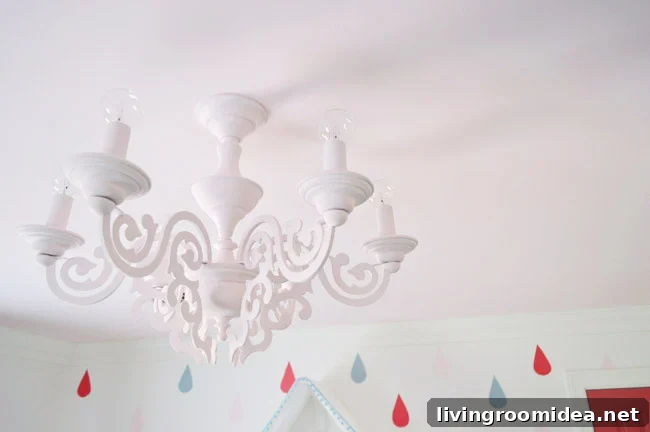
Continuing a recent trend in our house, Clara is the latest family member to get a ceiling fixture in her room. I half expect Sia to burst into song about it (“from the chan-de-li-eeeer!”).
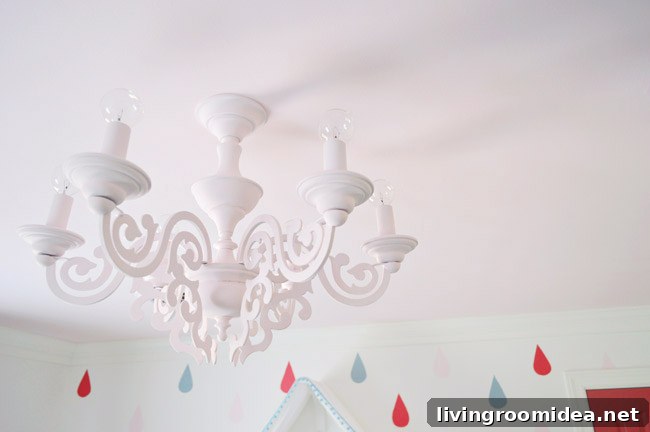
If the chandelier looks familiar, it’s because a version of it used to hang in our dining room. It came with the house, and while the finish wasn’t exactly our style, the swirling flat arms and intricate paper-like silhouette always appealed to us. We thought it might be perfect for Clara’s room if we could shrink it down a bit.

The main issue was size. Even with no chain, the chandelier would hang roughly 26″ from an eight-foot ceiling, which is dangerously close for a six-foot-tall parent. Since shrink rays aren’t sold at Home Depot, I removed the fixture to see if I could shorten it myself.
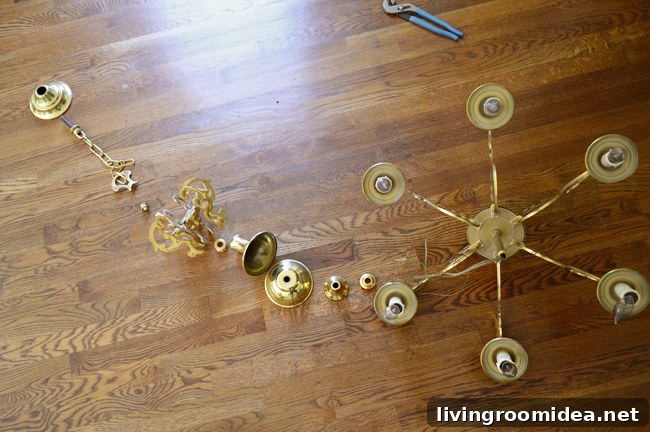
By loosening a single screw at the top I was able to take apart the nesting pieces that create the chandelier’s ornate shape. I laid them out in order so I could remember how to reassemble them. What remained was a long center post that I could spool pieces back onto.
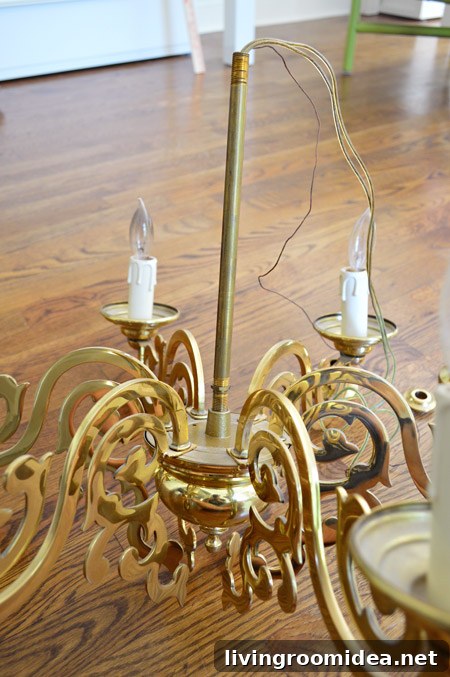
My plan was to keep most of the decorative elements but remove enough of the hanging hardware to reduce the overall drop. The long center post posed a problem: shortening it with a hacksaw would remove the top threaded portion needed to reattach the fixture. Instead, I realized I could use that existing threading differently.

Rather than reconnecting the rod to the decorative loop and then to the canopy, I screwed the rod’s threaded end directly into the ceiling crossbar. That eliminated the height of the large hanging loop and removed several inches of drop without sacrificing strength. You never want a heavy fixture hanging by its wiring, so threading the metal post into the crossbar ensured a secure mount.
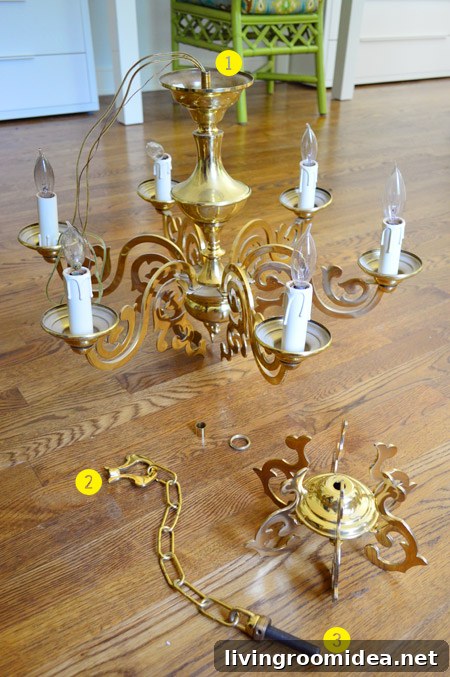
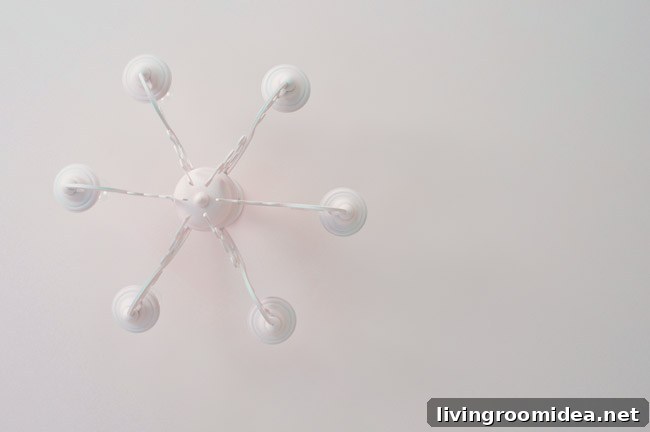
For clarity, I left out several original pieces when reassembling—shown above—and below is the original dining-room photo with the removed parts grayed out so you can see the changes.

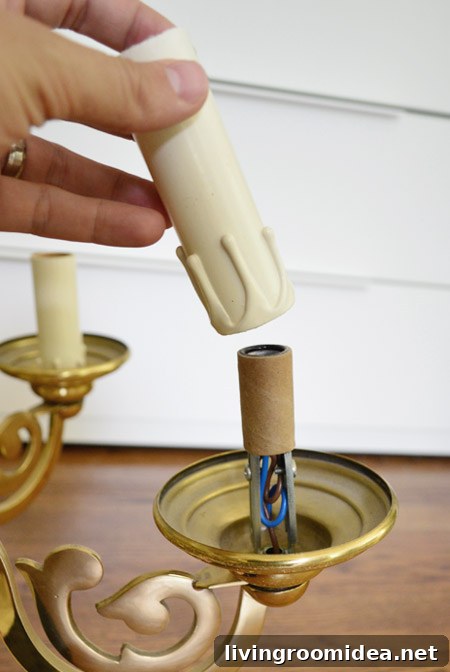
We also considered replacing the candle sleeves because the faux dripping wax didn’t appeal to us. Luckily, Sherry discovered that flipping the sleeves upside down hides the drips from view, so we didn’t need to buy replacements.
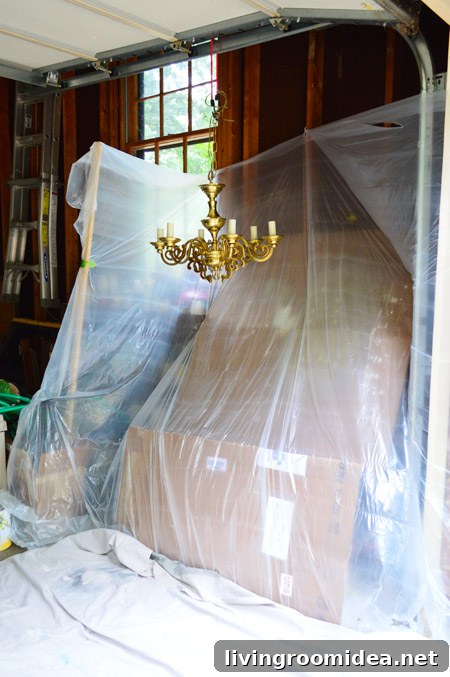
Next came painting. I set up a small station in the garage with a plastic drop cloth and hung the chandelier from a bungee and the original chain.
Sherry taped over the tops of the bulb sockets so paint wouldn’t clog them, then applied a coat of Clean Metal Primer as our base. After priming, the chandelier looked nice in white, but we wanted it to match the ceiling color exactly—Pink Cadillac—so the fixture would blend in and feel whimsical, almost Alice-in-Wonderland. When we asked Clara what color she wanted, she shouted “PINK!” without hesitation.
To match the ceiling precisely we couldn’t rely on an off-the-shelf spray paint. Our usual paint sprayer tends to lay down too much paint for intricate pieces, so we tried an inexpensive Preval sprayer to convert thinned paint into a spray. Unfortunately, it required a lot of trial and error. The instructions didn’t specify how thin the paint should be; it took many attempts to find a workable consistency. We ended up somewhere around one part water to two parts paint, but the exact ratio varied during the process.

The Preval sprayer was temperamental, sometimes sputtering or clogging and needing to be cleared. Even so, once it was spraying it laid down a lighter, mist-like coat closer to aerosol spray paint than our larger Graco sprayer, which can be heavy-handed and drippy on detailed pieces. It wasn’t perfect, but Sherry persisted until the chandelier was evenly coated.

The next morning we installed the fixture. It took both of us—Sherry supported the chandelier while I handled the wiring—so I didn’t get step-by-step photos (and my remote’s battery died). Essentially, I attached the ceiling crossbar and then spun the chandelier so the long center post screwed directly into it. We left just a half-inch of the post above the canopy to engage the crossbar, then tightened it so the canopy sits snug against the ceiling.

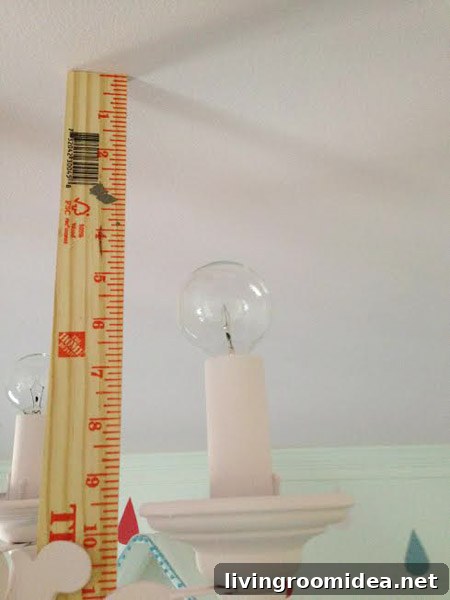
Those bulbs now hang about five inches below the ceiling, giving them breathing room on all sides—important for light and heat management. We worried the thinned paint might look lighter than the ceiling, but the finished color blends nicely and reads very close to the ceiling tone.
Cost for the update was minimal: about $5 for the Preval sprayer and $4 for an extra air can, plus new 25-watt bulbs. The result felt worth the effort—an old dining-room fixture reimagined as a playful, pink chandelier for Clara’s space.
It’s lovely to flip a switch and have a bright, cheerful light fill her room. Here the six 25-watt bulbs glow alongside Clara’s fairy lights.

And here’s a softer night shot captured on the iPhone.
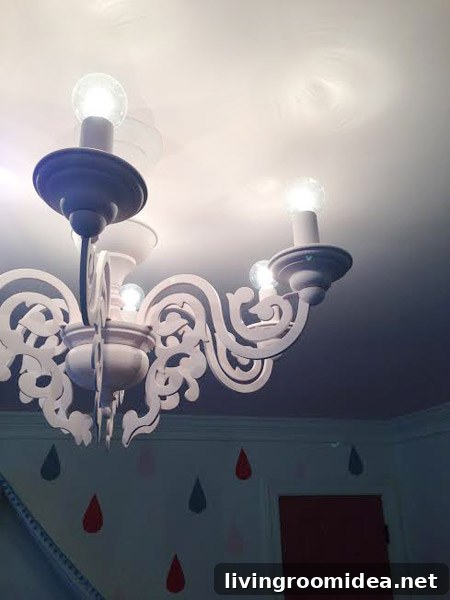
Clara loves her new chandelier—she declared, “It’s all swirly like it’s from Belle’s castle!”—which is high praise in our house. Teddy, being too small to comment, remains unimpressed for now.

For now the dining room is temporarily without a light, but that’s a small concern compared with other projects on our list. We still need to find a ceiling fixture for the guest room before our upcoming visitor, so the search continues.