
And now for a post about saving money. The less we spend on groceries, the more we can spend on paint and projects. Since I recently shared my 2011 goal to learn how to use coupons and save more, here’s a straightforward update for anyone else trying to turn clipped coupons into real savings.
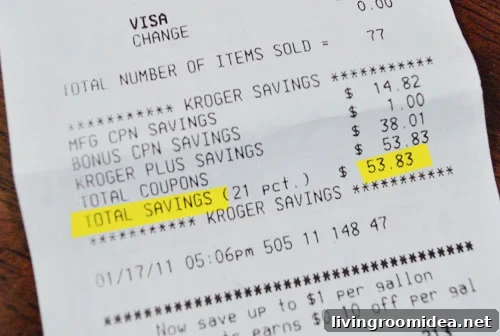
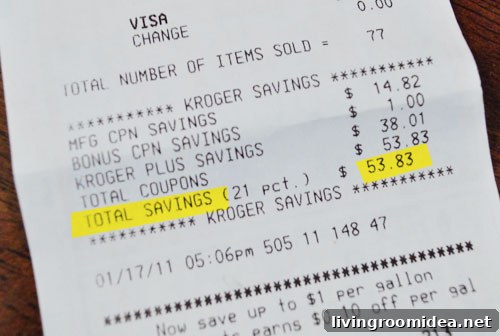
I saved $53 at the grocery store! Coupons really do work.
Excuse the excitement — I’m pleasantly surprised. I’m not an expert; I only started learning the coupon world a few weeks ago. But here’s what I picked up in simple terms. I needed things explained slowly and clearly, so that’s what I’ll do.
Tip 1: You save the most when your store matches coupons and when you can stack a manufacturer’s coupon with a store sale or coupon. We shop at Kroger, which matches manufacturers’ coupons up to 50 cents. For example, if Kroger has organic milk on sale for $1 off and I have a manufacturer’s coupon for 50 cents off that Kroger matches, a gallon that usually costs $3 can end up costing $1.00 after combining store sale and matched coupon.
Those kinds of savings add up, especially when you do one big shopping trip every 2–3 weeks like we do. It helps avoid frequent trips and impulse buys. Here are more of the simple coupon rules I follow.
Tip 2: Only use coupons for items you actually eat or will try. If you buy things just because they’re on sale, you waste money, time, and storage space. My rule is to clip or print coupons only for foods our family eats or wants to try. We prefer organic dairy and produce plus staples like pasta, bread, cereal, and granola. Coupons for those items are out there, and having a Kroger savings card helps too — some discounts load directly to the card and apply at checkout. Our last trip was our best yet: we saved $53 on a cart full of groceries.
Besides the Sunday paper, where many coupons and store fliers appear, I visit a few trusted online sources to find printable coupons or offers that can be loaded to the store card. A handful of sites give me most of what I need, so you don’t have to bookmark everything and get overwhelmed. I experimented until I found favorites that work for me.
- Use coupon aggregator sites to find weekly store deals and coupon match-ups — check the store-specific tabs (Kroger, Target, etc.).
- Look for the eCoupons section on those sites to load coupons to your store card directly.
- Visit popular printable coupon sites to print manufacturer coupons you can use at checkout.
- Check a few coupon blogs occasionally for new deals and strategy tips, but focus on a handful of reliable sources so you don’t get overwhelmed.
Other than those basics, the approach was simple: I clipped coupons for things we already use over a two-week span, made a careful shopping list that noted quantities needed to maximize savings, and loaded some e-coupons to our Kroger card before shopping. We spent about $160 for 2–3 weeks of groceries for the three of us. We bought 77 items and saved $53. Many of the biggest savings were on organic items we actually buy, like baby yogurt, milk, eggs, produce, bread, pasta, granola bars, and a few treats like dark chocolate and ice cream.
Here are a few concrete examples from our trip:
- YoBaby Organic Yogurt 4-packs: Each pack was $2.69. Kroger had $0.60 off each, bringing the price to $2.09, and we used a manufacturer coupon for buy one, get one free. Total for two 4-packs: $2.09.
- Gorton’s grilled shrimp (8 oz): Regularly $5.99; Kroger had a $3-off promotion so it was $2.99, plus a $1 manufacturer coupon meant we paid $1.99.
- Fiber One Granola Bars: Regular $2.49; Kroger sale reduced it by $1.50 to $0.99, and a loaded e-coupon for $0.50 brought the price to $0.49.
Not every item will have huge savings — many are small discounts. But those small savings add up when you stick to things you use. A few more couponing basics I learned:
- “10 for $10” deals don’t require you to buy ten items; they’re marketing tactics to encourage bulk purchases.
- Buying the largest size isn’t always the best deal. Sometimes a coupon on a smaller size yields a higher percentage savings. Check the price per ounce if you can.
- Coupons and sales can be cyclical. Many experienced shoppers say popular items go on sale about every six weeks. If you can store a reasonable amount, you can wait for the sale to recur rather than buying in excess the first time you see a deal.
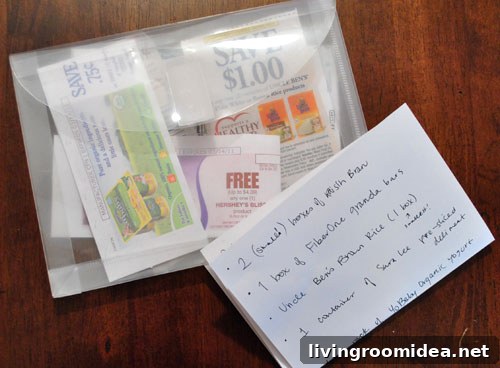
My organization method is simple: I keep clipped coupons in a clear plastic sleeve during the 2–3 weeks between major trips. Before shopping I remove coupons I won’t use so the sleeve only contains the ones I’ll spend, and I slip my shopping list in with them so I know exactly how many of each item to buy to match the coupons. At checkout I hand over my Kroger card for uploaded discounts, and then give the cashier the paper coupons. That routine has worked well so far.
That’s my coupon update — happy snipping. Experienced couponers: feel free to share tips. I’ve still got a lot to learn!
P.S. Not all kids’ toys are created equal. See what Clara got that looks so good we don’t want to put it away (unlike most of her other toys).