Today I have a special Sunday post for you from my friend Meagan Francis!
You probably know her from her blog and book, The Happiest Mom. I’m honored to have her share a real-life “fixer upper” story here. Thanks for welcoming her today! –Melissa
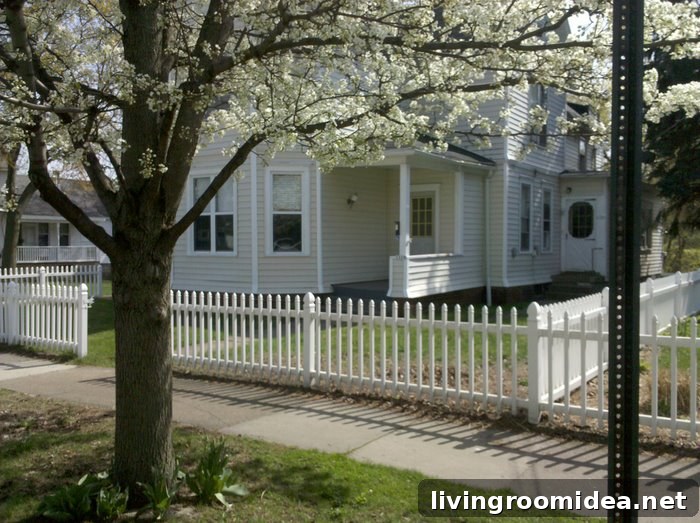
When we bought our house, I was searching for potential. A home large enough for seven people on a tight budget meant accepting a serious fixer-upper. Structurally the house seemed sound, but I assumed a few cosmetic updates—refinished hardwood and a renovated kitchen—would be straightforward.
Once we moved in, reality set in. The retaining wall behind the house collapsed into the ravine. We had to redirect water away from the old garage to prevent collapse. The furnace failed and needed replacing. One problem led to another, and unglamorous, essential repairs consumed the budget I’d hoped to use for cosmetic changes.
As a result, the two projects I wanted most—refinishing the first-floor hardwood and updating the awkward, dated kitchen—were postponed. For a year and a half the floors stayed hidden beneath a mismatched patchwork of stained rental Berber, beaten wood, and vinyl tiles. In the kitchen we managed only some quick fixes: a fresh paint color to cover hideous mint green and a bit of open shelving.
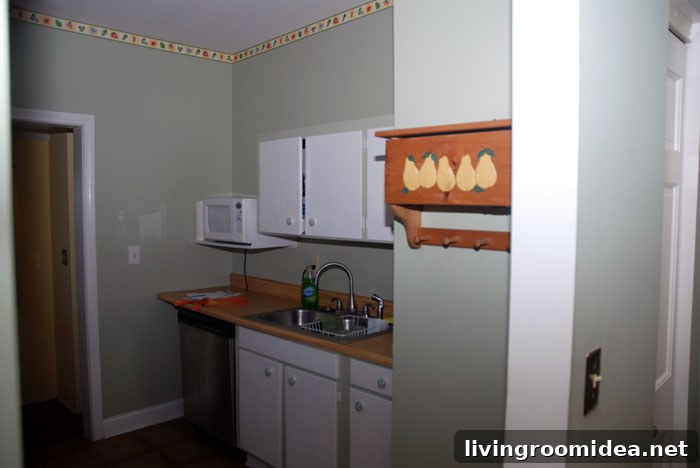
Every time I walked across those floors or cooked in that kitchen I felt annoyed. I imagined how much nicer the house would be after the updates and how much happier I’d be once everything looked the way I pictured it.
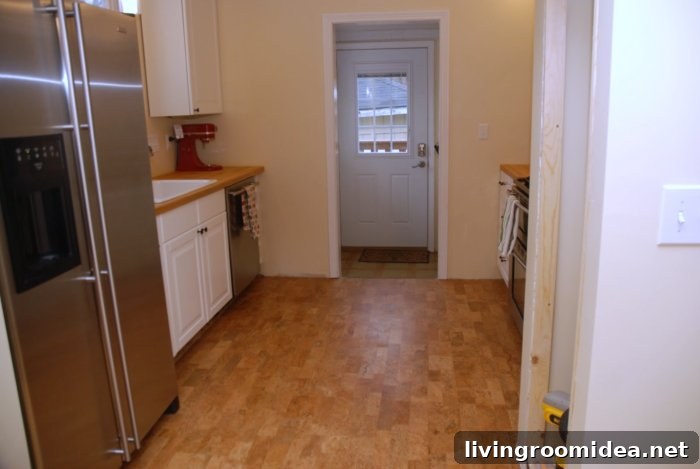
Eventually we scraped together enough money to tackle both projects at once. We stayed with my mother-in-law for the weekend so the crew could install cork flooring in the kitchen and refinish wood throughout the first floor. When we returned we were asked to avoid the floors for a day or two, so we had to admire the work from a distance and head upstairs to camp out.
The house had been a duplex for many years, and upstairs still feels like a low-rent apartment. It contains the boys’ bedrooms, a bathroom, what used to be a kitchen, and a TV/game room. The kids love having a hangout upstairs, but visually it isn’t much to look at. We have plans to improve it someday, but for now it remains basic.
That night all seven of us squeezed into the TV room and the boys’ bedrooms. Lying there in the dark—surrounded by ugly carpet, crumbling plaster, and faded yellow walls—I was transported back to the small apartments my husband and I shared when our oldest children were young. Those places had aged kitchens and cheap rental carpet, but they sheltered us, warmed us, and witnessed our family’s growth. At the time I never felt those homes were inadequate. I cleaned them, decorated within my limited means, and took pride in what we had.
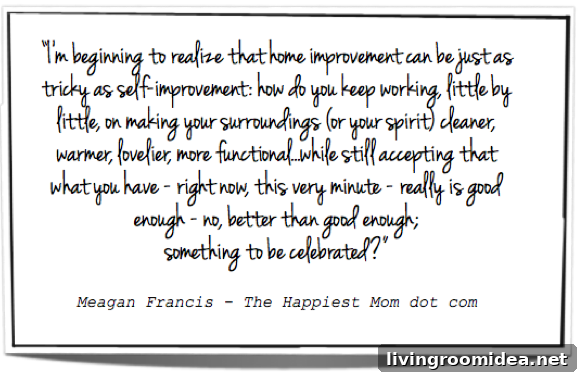
Over the years our income and expectations changed. Now, with more resources, it’s easy to focus on what’s next and what still needs improving. I’m learning that home improvement can mirror self-improvement: you work steadily, bit by bit, to make your space cleaner, warmer, and more functional, while also accepting that what you have right now is good enough—worthy of celebration.

As I listened to my family’s steady, sleeping breaths that night, crowded together in a room many would consider too small, it struck me: this is enough. The updated kitchen, the refinished hardwood, the matching towels—those are the extras that make life more enjoyable, but they’re not the core of what matters.
I love our new wood floors and the nearly finished kitchen, but I also accept that our house will be “under construction” for a long time. There will always be something I want to change or improve. The real challenge is to embrace the home in the meantime, to appreciate it for what it provides: warmth, comfort, and a place that keeps our family together.
