
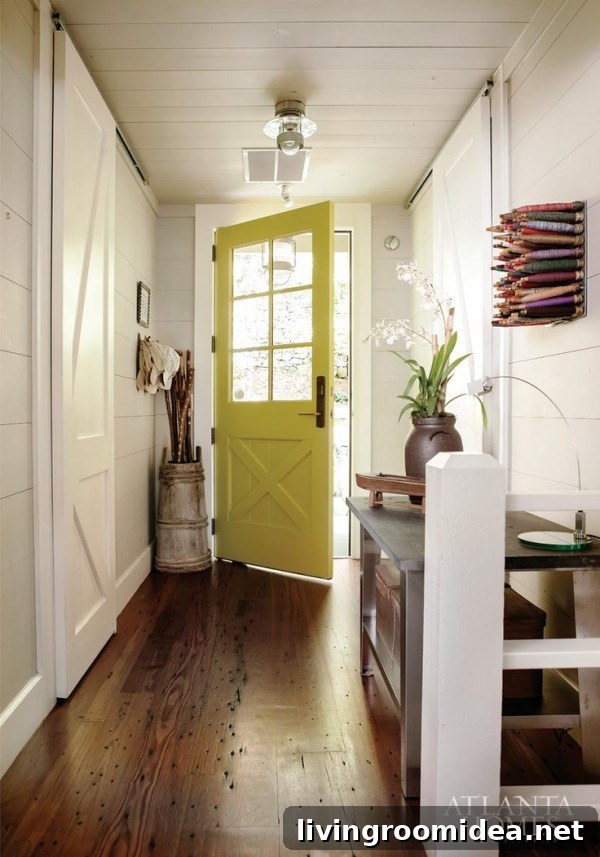
via Atlanta Homes
“I’ve always loved quirky things that are mixed with classic,”
says Ann, the homeowner.
“More than anything, I wanted this house to be fun.”
That sentiment — combining quirky details with timeless elements — creates a home that feels both personal and enduring. It’s a simple philosophy, but when applied thoughtfully it produces interiors that are lively without feeling chaotic, distinctive without being trendy for trend’s sake. In Ann’s entry, the bright door and unexpected touches invite a smile while the balanced proportions and classic materials keep the space grounded.
Thinking about your own home in descriptive terms can be surprisingly useful. Choosing a few words that capture the mood you want — cozy, elegant, playful, minimalist, warm — helps guide decisions about color, furnishings, and accessories. When you decide you want a space to feel “fun,” for example, you might allow for bolder color choices, inventive patterns, or whimsical art. If your word is “classic,” you’ll gravitate toward traditional silhouettes, quality finishes, and a restrained palette. Combining those words, as Ann did, gives you permission to blend unexpected details with a stable framework.
Designing with a few guiding words also helps avoid unnecessary repetition or overloading a room with too many competing ideas. Rather than collecting every appealing item, you can weigh each piece against the words you’ve chosen. Does it reinforce the feeling you want, or does it pull the room in a different direction? This approach keeps a home cohesive while still allowing personal expression.
Practical choices matter too. A bright, welcoming entry like the one pictured often benefits from durable finishes and easy-to-maintain surfaces so that playful elements can endure everyday life. Storage solutions and thoughtful placement of hooks, benches, or consoles make a lively entry feel organized rather than cluttered. Lighting is another important factor: layered lighting with ambient, task, and accent sources gives depth to both classic and quirky details and ensures the mood you intend is visible at every hour.
Texture and scale also play key roles in balancing personality with permanence. Mixing warm woods, woven textiles, and matte metals with a few polished or glossy accents creates visual interest without overwhelming the eye. Keeping scale in mind prevents small details from looking insignificant or large pieces from dominating the room. In Ann’s case, the bright door acts as a focal point while surrounding elements are scaled and placed to support that focal point.
Color strategy is another tool for striking the right balance. A neutral base allows quirky elements to pop without clashing, while a limited accent palette ties playful features together. Small bursts of color — in a lamp, a rug, or a painted trim — can make a space feel intentional rather than random. Alternatively, committing to a bold color in one prominent place, like an entry door, creates a memorable first impression while keeping the rest of the palette more subdued.
Finally, remember that a home evolves. Your chosen words can change over time as your tastes and needs shift. What matters is using those words as a compass: they point you toward choices that feel authentic and coherent. Ann’s desire for a home that’s both quirky and classic demonstrates how combining a few clear intentions produces results that are joyful, livable, and uniquely yours.
So, do you ever think about the words you would use to describe your home? Taking a few moments to name the feelings you want your space to evoke can make every decorating decision easier and more meaningful.