
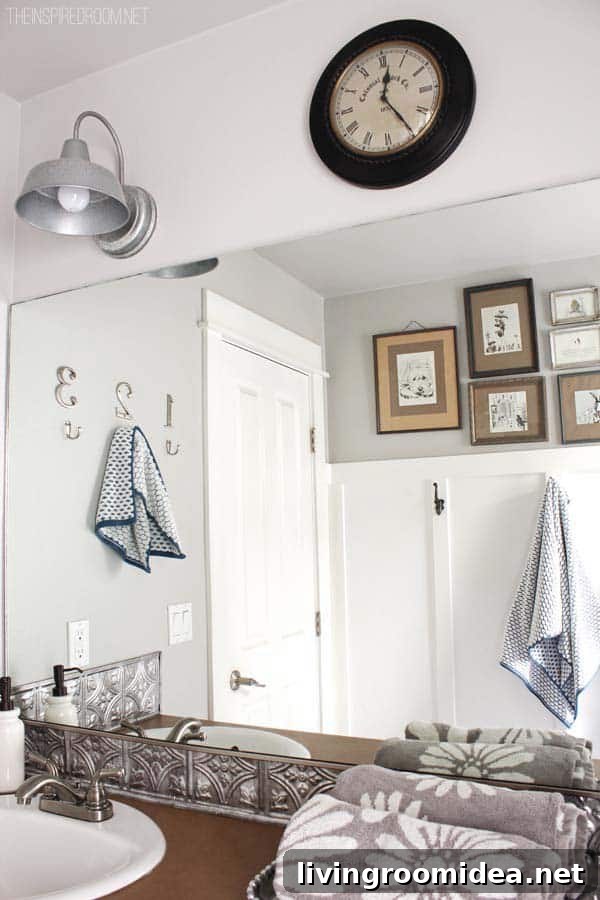
Easy DIY: Installing Faux Tin Ceiling Tiles as a Backsplash
Thank you for the kind comments on my kids’ bathroom facelift and for the enthusiasm about the faux tin tile backsplash. If you missed the full bathroom makeover post, it explains the project and the reasons behind the choices I made.
This project was meant to be a quick, affordable update rather than a perfect, permanent renovation. Accepting a few imperfections kept the cost and time low, and lets you change things later if you want. The result is a dramatic visual update you can install yourself without specialized tools or professional help.
Materials and tools you’ll need:
Step-by-step faux tin backsplash tutorial
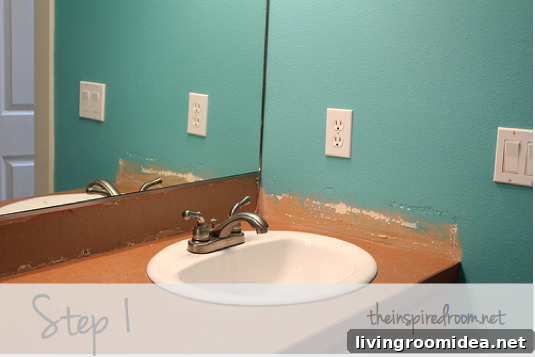
STEP 1: Remove the existing backsplash and any metal trim. Clean the wall and counter of debris and dust so the new tiles will adhere properly. In many cases you can install the faux tin over a Formica backsplash, but metal trim or bulky edges might need to be removed first.
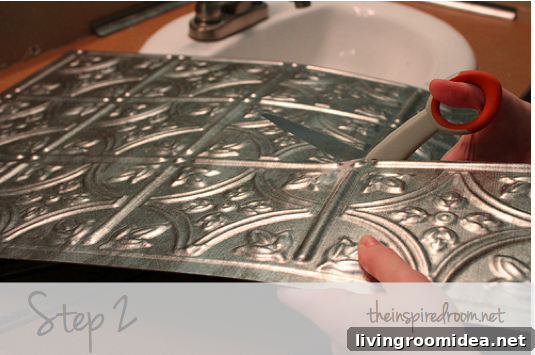
STEP 2: Measure the area and cut the faux tin squares to fit. Thin faux tin tile cuts easily with sharp scissors. Cove molding and edge trim pieces are thicker and may require very sharp shears, a utility saw, or another cutting tool. If you don’t enjoy cutting, ask someone with stronger scissors to help.
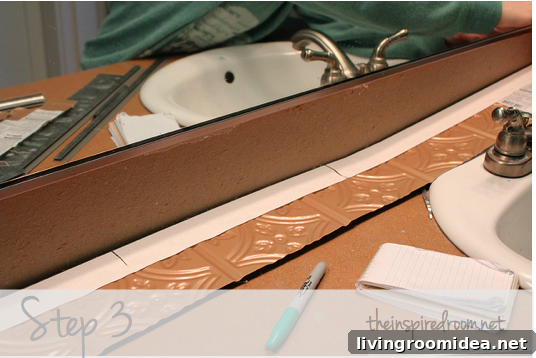
STEP 3: Apply double-sided adhesive tape to the back of each tile, leaving the paper liner on until you are ready to press the tile to the wall. Place tape along the edges and across the center for a secure hold. Also add tape to the cove molding and any trim pieces.
STEP 4: If you have tight spaces—like the gap between a mirror and the counter—you can tuck the tile slightly under the mirror instead of adding an upper trim piece. Fitting tiles in narrow gaps can be fiddly: trim pieces gradually until each tile lies flat and sits into the lower cove molding. An extra pair of hands makes this step much easier.
The trim pieces cover exposed raw edges; they snap on similar to report covers or plastic edge trim. The cove molding at the base hides the joint between tile and countertop and gives a finished look.
STEP 5: When all tiles are positioned, remove the tape liner and firmly press each tile to the wall, holding briefly to ensure adhesion. The tape allows repositioning if a tile is misaligned—just peel and try again. For larger installations or ceilings you might consider a heavier adhesive, but double-sided tape worked well for this backsplash and kept the installation simple and reversible.
Puzzle the tiles together until the pattern looks complete. If a tile loosens later, add more tape or replace the adhesive. I installed this backsplash nearly a year ago and it’s still in place with no problems. When the counters are eventually changed, the tiles will be easy to remove and could be reused.
Note: These tiles are not suitable for wet areas like shower surrounds. They work well on walls, backsplashes, and even cabinet door inserts. You could also consider coordinating the counter with metallic paint and a sealant in a future update.
The faux tin tile has held up well in a busy boy’s bathroom for several years. If you try this tile in your home, I’d love to see photos.
This approach is a practical middle ground between DIY updates and full renovation. Compared to the cost, time, and mess of other backsplash options, faux tin tiles offered the visual impact I wanted with minimal disruption.
Have a great day!
More bathroom design inspiration (search your preferred sources for ideas and tutorials):
Beautiful Bathroom Remodeling Ideas
Pretty & Functional Bathroom Storage Ideas
5 Navy & White Bathrooms
Beautiful Bathroom Vanities
Lovely Bathroom Storage Solutions
Bathrooms with Trough Sinks
Inspiration: Repurpose Furniture Into Bathroom Vanity
Divided Master Bathrooms: Jack & Jill Style
7 Inspiring Bathroom Designs
Inspired By: Clawfoot Tubs
Wallpapered Powder Bathrooms
Cottage Style Bathrooms
DIY Faux Tin Ceiling Tile Backsplash