
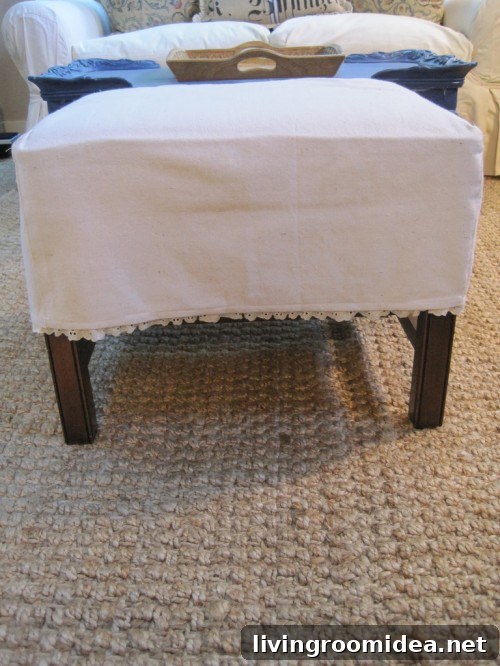
Living room: inexpensive drop cloths unify mismatched furniture.
{Sofa was hunter green. Ottoman was blue and pink plaid.}
Do you wish your home looked more put together? Do you want a warm, welcoming room but are living with hand-me-downs or older furniture that feels disjointed? You don’t need to replace everything. With a few simple edits, you can make what you have work together.
Here’s the approach I use.
To be happy with your home:
Your house doesn’t have to be perfect.
Your style doesn’t have to be the latest trend.
Your furniture doesn’t have to be new or expensive.
You can mix different furniture styles.
Your surfaces don’t need professional-level styling.
You don’t need certain architectural features to make a room feel finished.
{Pause to let that sink in.}
Those things are nice, but they aren’t required. If your room feels chaotic or nothing seems to match, you’ll be tempted to think you need all new furniture. Often the real solution is editing what’s already there: reduce competing colors, minimize too many wood tones, and choose a cohesive palette. Once I start editing, things come together without buying a lot of new pieces.
When I remove random colors and conflicting wood finishes to create a consistent color story, the room starts to feel intentional using what I already own.
My home isn’t perfect, and I’m still working on it, but I always try to make the most of what I have. Perfection isn’t the goal—finding practical solutions is. My furniture once ranged from hunter green to pink toile with oak, dark and pine finishes. I needed to unify those pieces so they could coexist peacefully.
Unifying random accessories with paint eliminates the chaotic feeling of “nothing goes together.”
Dining room solutions:
- Mismatched woods and chairs were tied together with white or green paint and drop cloth slipcovers.
- White plates and pitchers were added as repeating accessories to create visual unity.
- Small paint updates to walls and trim can remove dated colors and further harmonize the space.
This cabinet was oak before painting.
Family room strategy:
- Worn rattan chairs were unified with simple white paint and black-and-white slipcovers.
- White frames and green shutters repeat color and tie accessories together.
- Soft green walls carry the accent color through the space for consistency.
Shades of green, white and black even appear in the bathroom.
Unifying doesn’t mean everything must match perfectly or that your home must be all white. Repeating two or three colors is often enough to create cohesion. For me, white, green and black form the core palette, but I still allow small pops of other colors to keep the house lively—especially with our gray Seattle winters, I prefer warmth and color indoors.
More white, black and a touch of green.
Yes, my dogs coordinate too—small repeating touches can make everything feel intentional.
White furniture is versatile because it allows you to introduce any accent color. The important principle is repetition: repeat colors and finishes you like across different rooms to create warmth and a cohesive look. Whether you prefer warm tones or cool, repeating them will make your home feel more put together.
PS. Professionally made slipcovers are beautiful but expensive. I used inexpensive drop cloths and affordable fabrics for most slipcovers. A few pieces have custom slipcovers, but many are simple DIY solutions. There are plenty of slipcover tutorials available if you want to try basic sewing projects.
Do you ever feel like a room is disjointed? Try unifying furniture and accessories by repeating color and finish.
Find the rest of the 31 Day series on the original blog.